

Artificial intelligence is transitioning into a system of autonomous economic agents operating independently of human decision cycles. These agents execute transactions, coordinate resources, and interact across networks continuously, resulting in a scale shift not measured in percentages but in orders of magnitude. A world with billions of independent agents implies trillions of micro-transactions executed at machine speed, where the marginal value of each action may be measured in cents or fractions of a cent. This introduces a fundamental constraint: no existing settlement infrastructure - Web2 or Web3 - is capable of sustaining such an environment.
Legacy financial systems were never designed for automated micro-settlement. Transaction processing is expensive, latency-heavy, and requires trust in intermediaries. Even if throughput capacity increased, pricing models and clearing mechanisms make continuous machine-level activity impractical. Public blockchains inherit a different limitation. Their bottleneck lies in consensus execution, where every node is required to validate and re-execute computation. As activity increases, fees rise and throughput collapses. Scaling behavior is linear: more users produce more congestion and more cost. Rollups and parallelization extend the ceiling but do not remove the underlying bottleneck.
Zero-knowledge proofs restructure distributed systems by relocating computation from the network to the edge. Instead of all nodes re-executing transactions, computation occurs on the device or the autonomous agent, and the agent produces a succinct proof attesting that execution followed the correct rules. The network verifies the proof rather than reproducing the computation, collapsing global verification cost to a constant and enabling throughput growth independent of demand. Scaling becomes a prerequisite, not an optimization, for machine-native networks.
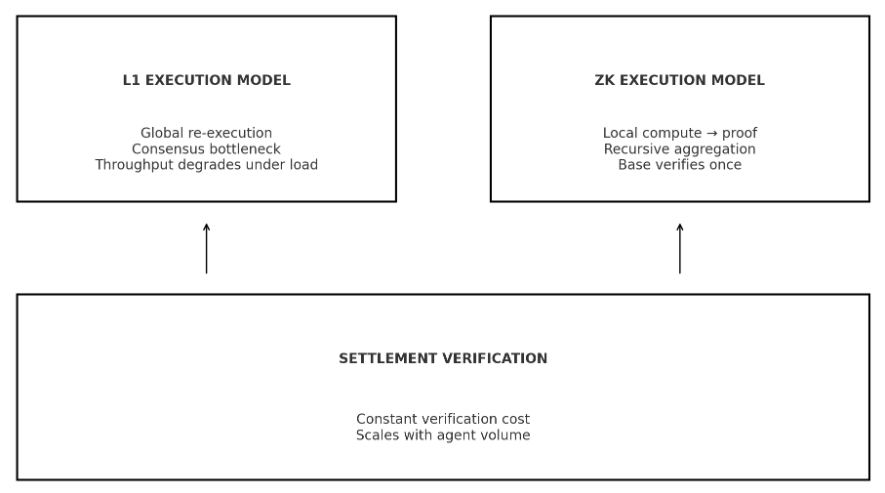
The emerging agentic internet requires settlement primitives fundamentally different from those used today. For autonomous economic agents to function, a settlement layer must support extremely high-frequency, low-value, programmatically generated transactions with minimal latency and predictable execution.
Requirements include:
Micropayment architectures such as x402-style request-response flows and continuous AI-agent payment streaming depend on these properties. Without them, the system collapses - either fees exceed transaction value, or latency prevents coordination. This is the fundamental reason current chains and legacy financial networks are insufficient: their assumptions were built around human throughput, not autonomous computation.
Psy Protocol introduces a base-layer system designed for this environment, pairing client-side proving with a Proof-of-Useful-Work consensus mechanism. Rather than expending energy on random hashing, miners verify and recursively aggregate proofs generated by agents.
The result is a network capable of sustaining millions of transactions per second and maintaining predictable behavior regardless of load. Privacy is inherent because proving occurs locally, allowing agents to transact without revealing internal logic or sensitive data.

This positions @PsyProtocol as a fundamental departure from rollup-centric scaling models. Where zkVMs, prover networks, and DA solutions address computation, proof distribution, and data throughput, Psy targets the settlement bottleneck itself - the component that all other systems ultimately depend on. It is built for an environment where the dominant transaction originator is not a human pressing a button, but an autonomous process coordinating continuously.
If autonomous agents become primary economic participants, the settlement layer must behave predictably under extreme load, price micro-transactions near zero, and preserve privacy as a default property. Legacy payments rails and adapted blockchain architectures cannot evolve into this structure. Zero-knowledge integrated into the base protocol can.
Psy Protocol represents one of the earliest credible implementations of this design direction.