


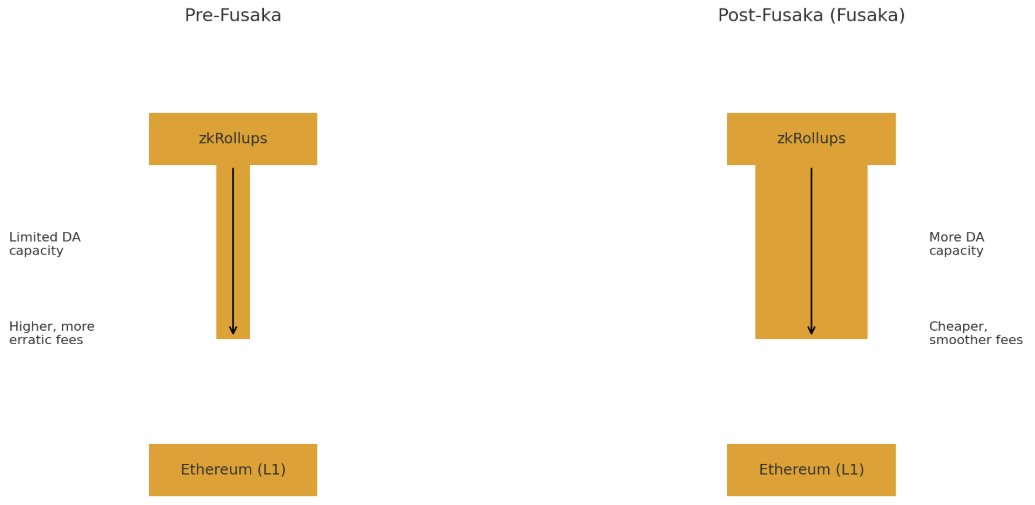
Ethereum’s Fusaka upgrade is a rollup-centric change. It does not modify zk proof systems, but instead changes the conditions under which zkRollups operate: how much data they can post to Ethereum, how that data is priced, and how much work the base layer can safely handle.
For anyone using zkRollups, Fusaka is about making L2 blockspace cheaper and more scalable while keeping @Ethereum’s security and decentralization intact.
A zkRollup depends on Ethereum for two core things:
Since Dencun, that DA step has used special “blob” space attached to blocks. Blobs are cheaper than normal calldata but still counted as a shared resource. For many rollups, blob usage is the dominant cost and the main ceiling on throughput.
Before Fusaka, every full node had to download all blob data. That meant Ethereum had to be conservative about how many blobs per block it allowed and how fast it could increase those limits, because every extra blob directly raised node bandwidth and storage requirements. Even with good compression, the base-layer DA capacity remained the tightest constraint.
Fusaka introduces PeerDAS, a data-availability sampling scheme for blobs.
In practice, this means:
If sampling succeeds, the protocol can treat the blob as available with high confidence. If it fails, the blob is unsafe and will not be accepted.
The important consequence is that total blob throughput can grow much faster than per-node load. Ethereum can raise blob limits over time without forcing everyone to upgrade to data-centre hardware.
For zkRollups, this directly translates into:
The next piece is the blob fee market.
Post-Dencun, blob pricing had some awkward behaviour. Blob fees could sit near zero for long periods even when the execution layer was busy, then jump sharply when demand spiked. That made economic planning tricky and encouraged designs that implicitly assumed “DA is practically free” in the long run.
Fusaka changes this by tying blob fees more tightly to overall network conditions, so they cannot stay unrealistically low while the chain is congested. It pairs that with higher blob capacity from PeerDAS, so extra demand can be met by more supply rather than only by higher prices.
For zkRollups and their users, the effect is:
From a user perspective, you mostly see this as L2 transactions trending cheaper and fee spikes becoming less extreme.
zkRollups also depend on Ethereum for on-chain components:
Fusaka increases the overall block gas limit, giving more total computation per block, but introduces hard caps on gas per transaction and on encoded block size. This combination gives more space for all the settlement, bridge, and coordination logic rollups need, whilst preventing single oversized transactions or pathological blocks from monopolising resources or breaking block propagation.
The base layer becomes a more capable hub for many rollups to share, without sacrificing the property that a regular machine can still run a validating node.
Fusaka also improves deterministic visibility into upcoming block proposers.
With clearer proposer lookahead, Rollups and shared sequencers can better plan when they post blobs and settlement transactions. They can also design stronger preconfirmation schemes, where users get early, Ethereum-aligned assurances about inclusion.
For users, the technical details are abstracted away. The tangible outcomes are fewer surprises around delayed inclusion or occasional rollbacks and smoother UX for applications that advertise fast, but still Ethereum-secured, finality on L2.
At the network level, Fusaka pushes Ethereum deeper into its rollup-centric roadmap in a controlled way:
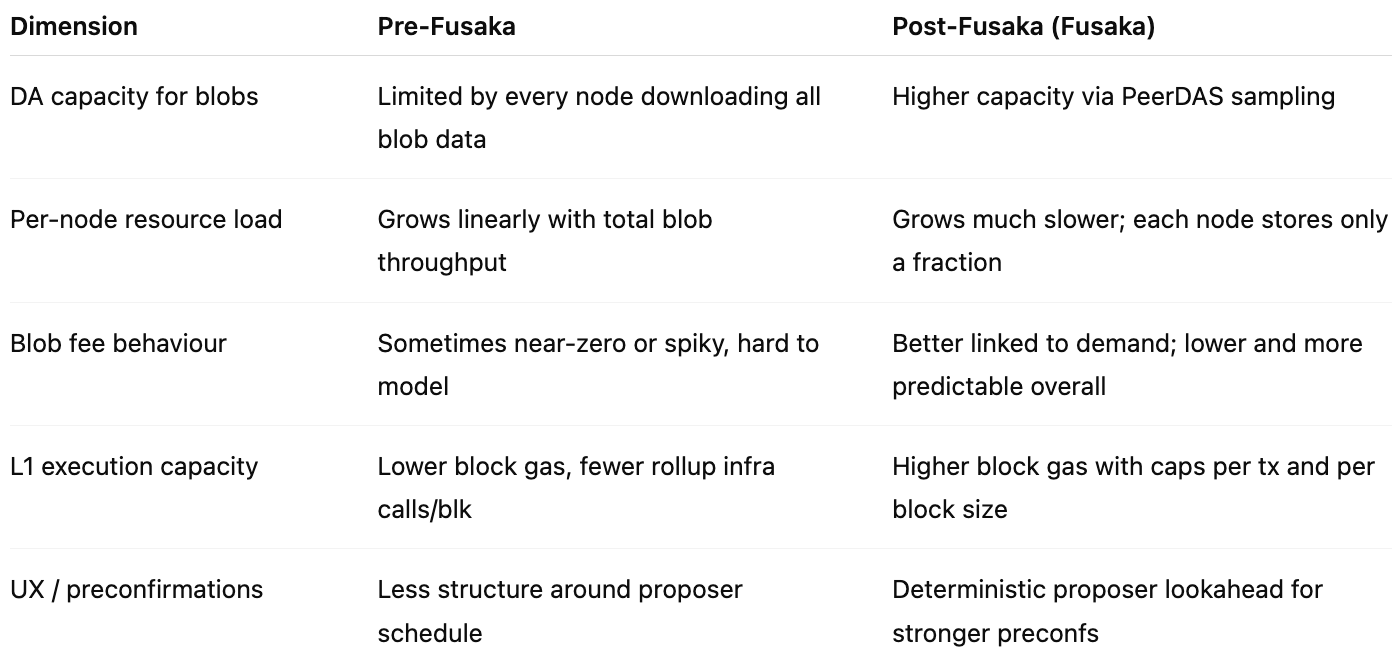
For zkRollups specifically, one of the hardest fundamental constraints is relaxed. DA on Ethereum becomes less of a fixed ceiling and more of a scalable resource. The limiting factors shift back toward where they belong: proving performance, aggregation, and product design.
For everyone else - the people just trying to use Ethereum through L2s - the implication is this: zkRollups get more headroom to grow, fees have more room to fall, and Ethereum stays credibly decentralised while it happens.