

House of ZK has been taking some time to reflect lately on where the industry is going, and what's important. We've been a staple of the ZK industry for the past couple of years or more, but we made the decision to dial in hard on the area of crypto we feel could end up mattering the most.
Bitcoin isn't going anywhere. Besides possibly just Ethereum, it's pretty hard to say that with any certainty about the rest of crypto. But Ethereum is already catered for, supporting a wide range of DeFi applications for using ETH natively. Bitcoin doesn't have this luxury. The dominant cryptocurrency is at risk of becoming something we use only through centralized institutions, which defeats the entire point of why it exists.
Bitcoin is supposed to be an asset that we custody ourselves, own ourselves, and transfer directly between ourselves. The point was, and should still be, to make obsolete the very institutions that are now taking it over.
Bitcoin L2's could be our last hope. Without a way to make Bitcoin actually useful in our daily lives, for payments, lending, borrowing, etc - all without requiring a trusted intermediary - then Bitcoin is lost. And by extension, so is crypto.
This is why we're dialling in on the Bitcoin economy. This is why this is so important.
We hope this article helps you to understand this more deeply and to analyse the current state of this crucial sector.
Why Bitcoin L2’s have failed so far
The first wave of “Bitcoin L2s” failed for a simple reason: they weren’t actually Bitcoin L2s. They were sidechains with trusted bridges. The term “Bitcoin L2” was essentially misused and overloaded.
Only now - because BitVM2-based bridge designs have compounded into real deployments and public testnets - do we have the beginnings of credible, permissionless exit back to Bitcoin as something you can evaluate in real, public systems. Citrea’s mainnet launch and GOAT Network’s public BitVM2 testnet are some of the clearest near-term signals of that transition.
A precise definition that resolves the ambiguity:
A system deserves the “Bitcoin L2” label (in the security sense) if a user can exit to Bitcoin under Bitcoin’s consensus rules even when operators, sequencers, committees, or intermediaries are offline, malicious, or uncooperative.
Most early “Bitcoin L2” systems did not meet that bar. They optimized for UX and time-to-market by using bridges secured by custody, federations/multisigs, or honest-majority assumptions. Those models can work commercially, but their failure mode is always the same: humans must agree to release funds.
BitVM2-based designs aim to remove the failure mode. They aim for a bridge where the failure case is secured by highly probabilistic economic game-theory. Disputes essentially resolve in a way Bitcoin can enforce, provided at least one honest challenger can act within the protocol’s windows.
That is the actual difference between “another chain that accepts BTC” and “a Bitcoin-enforced L2.”
It seems natural and obvious that BTC holders want functionality - yield, leverage, settlement, trading - but the historical path to those outcomes has been counterparty exposure. BTCFi TVL expansion during 2024 made the category legible at scale, while keeping “bridge trust” as the gating variable.
Second, once BTC becomes programmable, activity tends to concentrate around the same primitives that dominate elsewhere: stablecoins, credit markets, exchanges, and settlement rails. Citrea’s mainnet positioning is explicitly “lending, trading, and settlement,” which is exactly this gravitational pull.
Third, Bitcoin’s base layer constraints create an execution vacuum. Even teams approaching this from an Ethereum L2 background (for example, Starknet’s stated Bitcoin roadmap) converge on the idea that expressiveness must live offchain, with Bitcoin as a settlement and enforcement anchor.
So the question is not whether the market will keep trying. The question is whether bridge designs can make the “no-permission exit” promise credible at realistic cost.
BitVM2 is best understood as a practical pattern: do computation offchain, and use Bitcoin transactions as a dispute mechanism to enforce correctness. The point is not that Bitcoin executes the computation; it’s that Bitcoin can adjudicate a challenge path that forces the right settlement outcome.
What BitVM2 changed is that it made “Bitcoin-enforced exit” feel close enough to engineer. It also revealed the hard constraints that follow you into production:
This is why the newest work is so focused on reducing the onchain footprint of disputes by orders of magnitude. Alpen’s Glock claims hundreds-of-x efficiency improvements versus BitVM2 using garbled locks plus a designated-verifier SNARK (DV-Pari). Ideal’s Argo is positioned in the same direction: make the “prove the other side lied” step cheap enough that permissionless challenging is fully economically viable.
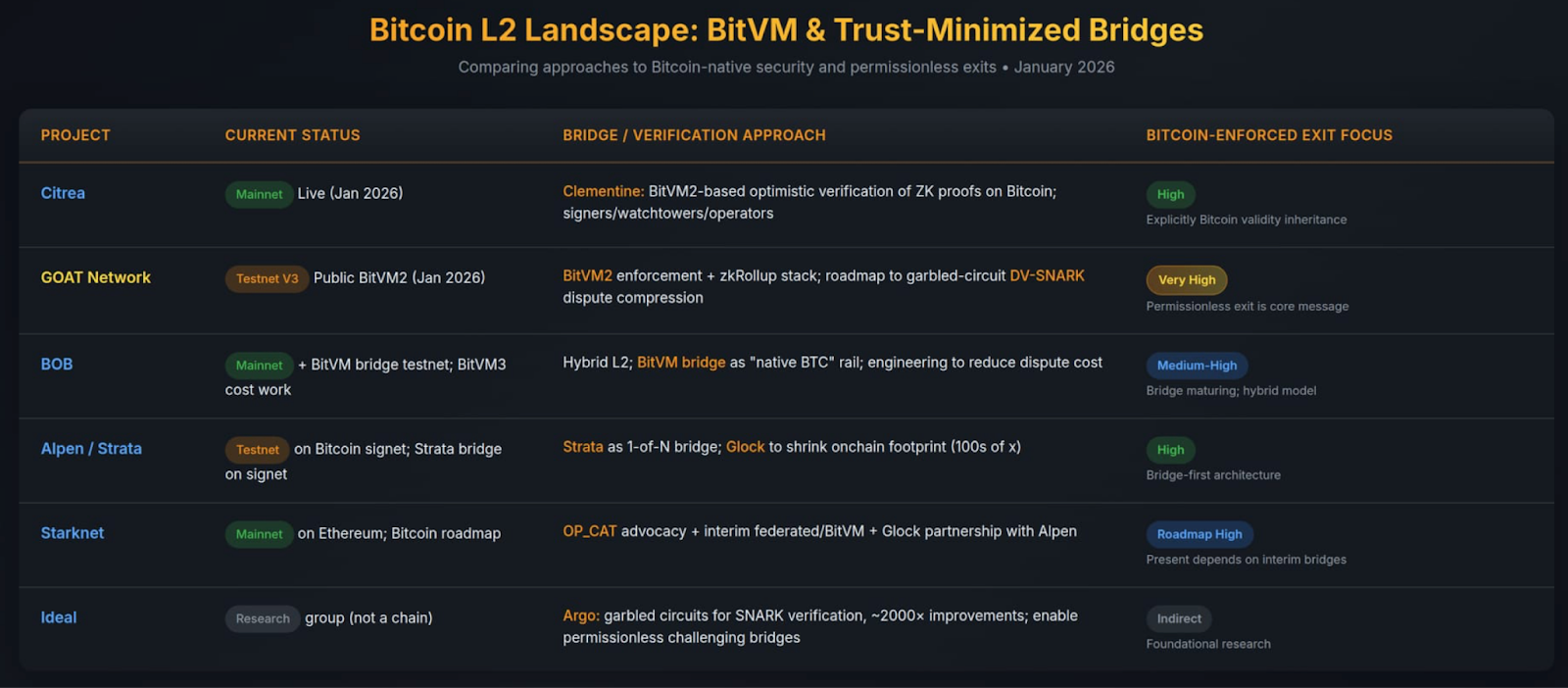
Citrea announced mainnet live on 27th Jan 2026 and frames itself as enabling lending, trading, and settlement for Bitcoin. The important part is not the zkEVM branding; it’s that their native bridge story is explicitly BitVM2-based (“Clementine”), with roles and monitoring assumptions spelled out clearly as an operational system..
What to watch is not TPS or app count; it’s the lived properties of peg-outs under stress: who can challenge, what conditions must hold, and what happens when roles fail.
GOAT Network’s public Testnet V3 launch (28th Jan 2026) is positioned around Bitcoin-native security, with Bitcoin as the enforcement layer for disputes and exits. The project’s own technical materials also point at dispute compression via garbled circuits and DV-SNARKs as the next frontier of making enforcement cheaper and more reliable.
The main evaluation axis is whether “permissionless exit” stays true and holds up as the system moves from public testnet constraints to mainnet operational realities.
BOB’s significance is strategy: bootstrap usage first, then harden “native BTC” bridging as a step function upgrade.
Their published roadmap includes BitVM3 onchain cost reductions via cut-and-choose enabled by VSSS and adaptor signatures, claiming an operator cost reduction and a ~$10.91 dispute headline figure.
This doesn’t mean the bridge is “done”. It is evidence that teams are now treating dispute cost as a primary product metric, because without that, permissionless challenging is fragile and the whole system would fail.
Alpen’s public direction has shifted toward Glock as a more practical bridge primitive than BitVM2 for economically viable challenge games, with published claims of 430×-550× onchain efficiency improvements depending on variant.
This yet again signals a maturing of priorities for Bitcoin L2’s: if your goal is Bitcoin-enforced exit at scale - and it should be - then the bridge primitive dominates. “Rollup vs commit chain” arguments are downstream of that.
Starknet matters because it brings an existing L2 ecosystem and deep proof expertise, while publicly advocating for OP_CAT as an accelerator and treating BitVM-class bridging as the best available path without it.
The strategic point is that even established major teams are framing Bitcoin settlement as bridge-first and upgrade-sensitive.
ideal positions itself around Bitcoin scaling primitives rather than another execution environment, with Argo as its flagship line of work aimed at making offchain SNARK verification (and thus permissionless challenging bridges) feasible at much lower onchain footprint.
If this class of work holds up, it could significantly reduce the gap in practice between “Bitcoin-enforced exit in principle” and “full permissionless exit in production and at scale”.
If “leading” means usage today, the leaders will often be the systems with the simplest bridging and best liquidity bootstrap, even if the trust model is weaker. That can be argued as rational behavior: users optimize for UX until they are forced to price tail risk.
If “leading” means Bitcoin-enforced exit shipped, the leaders are the teams operationalizing BitVM2-class bridging in public deployments and public testnets, because that is where the security definition becomes falsifiable. Citrea’s mainnet and GOAT Network’s public testnet are the cleanest current reference points for that shift.
If “leading” means pushing feasibility, the frontier is Glock/Argo-class dispute compression, because it targets the real bottleneck: dispute economics under Bitcoin fee spikes.
To us, leading means a combination of all three - and nothing less. Prioritizing user numbers with a weak trust model just gives us more of the same: “Bitcoin L2” as a marketing claim, but not by definition.
A working BitVM2-bridge, but with costs that make disputes impractical, also doesn’t cut it.
The near-term destination is not “one bridge to rule them all”. It is a convergence on bridge-first architecture, with a likely two-tier equilibrium:
The deeper consolidation dynamic will follow. Once credible exit exists and becomes legible to users, liquidity will cluster where exit is both credible and usable. In Bitcoin L2s, that consolidation pressure is stronger than on Ethereum L2s because bridge risk is harder to reason about and more catastrophic when misunderstood.
If you want a signal that matters, track bridge behavior as a first metric - not TVL, throughput charts, or anything else.
Look for three things:
Execution layers are commoditizing: EVM, zkEVM, alternative VMs, different sequencer designs. But the bridge is the differentiator because it defines the failure mode.
The first wave of Bitcoin L2’s failed because it treated the bridge as a secondary detail and shipped sidechains with trusted custody pathways. The second wave is credible precisely because it treats the bridge as the core component system, and BitVM2-class progress is now visible in public deployments and public testnets.
The projects that matter most in 2026 are the ones that can eventually make a single statement true in the real world:
“Your Bitcoin is safe even if we disappear.”
Visit hozk.io for more on the ZK-powered Bitcoin Economy.